Get updates from The Developer straight to your inbox Yes, please!




Size matters: Larger parks, longer visits and wildlife spotting improve mental health boost from urban green spaces, study reveals
What you do in the park matters too: Activities such as walking, running, cycling and picknicking can boost wellbeing too, major report reveals


Bigger is better when it comes to urban green spaces, a study has concluded after an investigation into the relationship between visits to urban parks and self-reported mental health benefit.
The dataset, collected as part of the Adults’ People and Nature Survey (PaNS) at sites across England, examined the well-being benefits of 10,727 visits across 3,744 green spaces. The visitors were evenly split between men and women, with 40-54 years old being the most common age group.
The survey is limited to respondents that can recall a visit to a green space in the past 14 days. The PaNS survey asked for details of the park’s location, what activities were engaged in during their visit, and whether the visit “was good for my mental health.”
The size of the green space was positively associated with the strength of the reported mental health benefit, as was the duration of the visit (which included journey time) – “a visit lasting one to two hours is 6.7% more likely to result in a ‘strong benefit’ compared to a visit of less than half an hour.”
Watching wildlife in an urban green space resulted in the greatest boost to reported mental health – the study suggests designers should prioritise habitat creation and wildlife engagement
The length of a visit can also partially compensate for the size of a park: “This interaction appears to be stronger for shorter visits – e.g. a visit of less than 30 minutes to a 10ha site resulted in an 8.6% greater chance of a ‘strong benefit’ over a visit of the same duration to a 1ha site, but only a 0.8% increased chance for visits between one and two hours.”
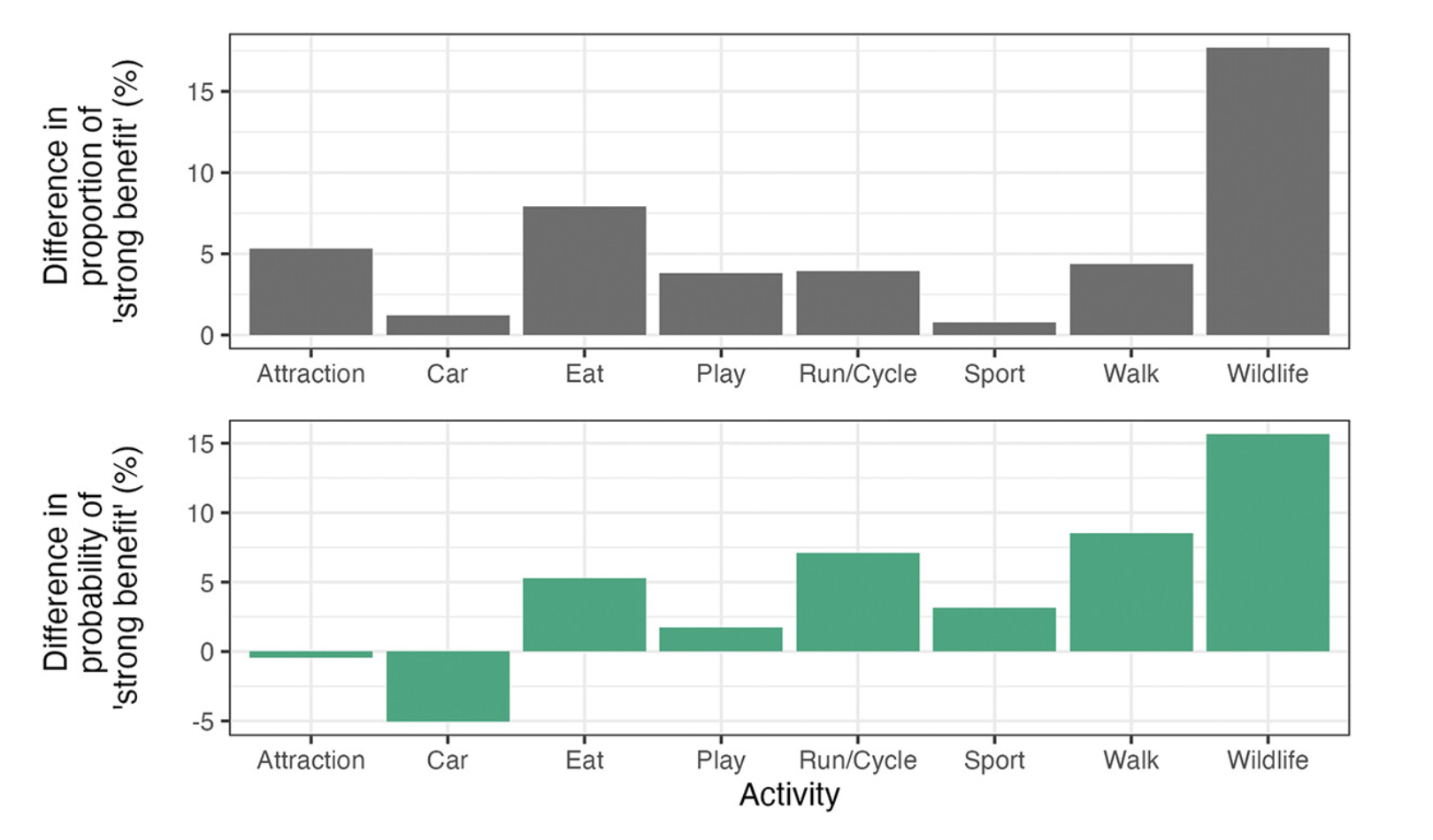
What you do in the park also matters: Those who spent time watching wildlife saw a 15.7% increase in the probability of ‘strong benefit’, with an increased benefit also linked to walking (+8.5%), running/cycling (+7.1%) and picnicking/eating (+5.3%).
The different natural features in the park didn’t appear significant: “Neither tree cover, grassland cover, nor blue space cover were significantly associated with benefit” – although spring visits were 2.9% more likely to result in a ‘strong benefit’ over winter visits.
Most respondents found their visit to an urban green space to be beneficial to their mental health – only 8.5% reported no benefit, while 50.8% experienced some benefit, and 40.7% received a strong benefit. One limitation of the study, however, is that it is biased towards users of green spaces.
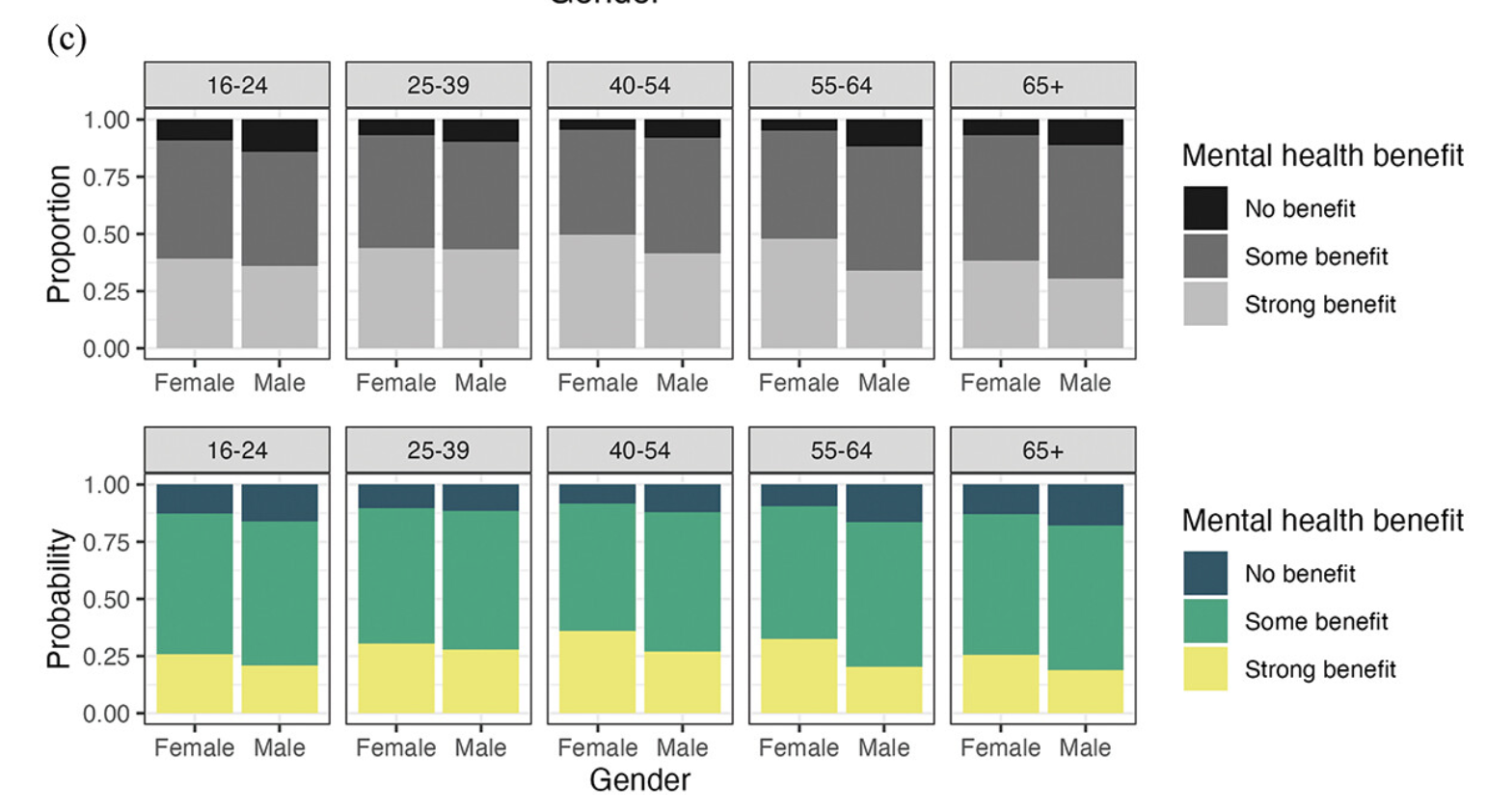
Women were 8.9% more likely to report a strong benefit of their visit when compared to men. The youngest age demographic, aged 16-25, reported the least mental health benefit of any age group
The survey collected the respondent’s age, gender, education level, marital status, work status, income, ethnicity and long-term illness, as well as dog ownership, number of children and recent frequency of physical activity.
Women were 8.9% more likely to report a strong benefit of their visit when compared to men. The youngest age demographic, aged 16-25, reported the least mental health benefit of any age group. Interestingly, owning a dog corresponded to a 5.2% lower probability of ‘strong benefit’ compared with non-dog owners.
People who work full-time recorded a greater benefit than people who work part-time, while people with no formal qualifications were 8% more likely to report ‘strong benefit’ to visiting an urban green space than people with a university degree.
More frequent visitors reported greater benefits: Respondents who visited a green space every day over the last year were 5.6% more likely to report a ‘strong benefit’ from their recent visit compared to people who visited more than twice a week and 13.9% more likely compared to those who visited less than once a week.
The researchers question whether the positive relationship between green space size and mental well-being could be explained by the larger sites providing “a greater sense of isolation from the visual and auditory stimuli of surrounding buildings, roads, and other hard infrastructure.”
“This explanation is supported by our observation that the increase in reported mental health benefit begins to plateau at greater urban green space sizes, where visitors might feel almost entirely isolated from stressful urban stimuli and more fully experience the sense of ‘being away’ that characterises psychologically restorative environments.”
The researchers recommend designers, policymakers and local authorities prioritise the creation of larger urban green spaces as well as creating habitats for wildlife and facilitating a wide range of activities in parks, with wildlife engagement, running, cycling, walking and picnicking all related to reported mental health benefit.
Sign up to our newsletter
Get updates from The Developer straight to your inbox
Thanks to our organisation members
© Festival of Place - Tweak Ltd., 124 City Road, London, EC1V 2NX. Tel: 020 3326 7238