Get updates from The Developer straight to your inbox Yes, please!




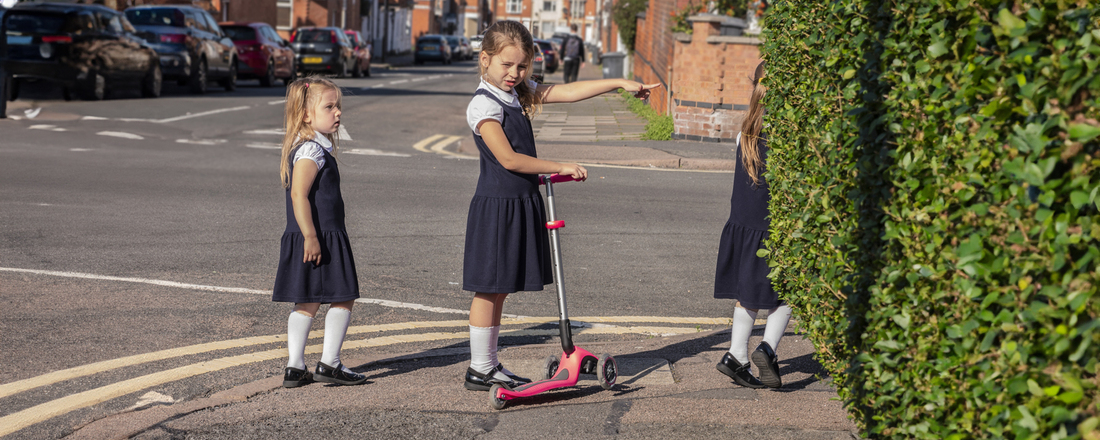
The unintended consequences of School Streets traffic restrictions
Major study shows street closures reduce car use and get children walking, but the spike in those parking and striding from boundary areas suggest careful planning is needed. Christine Murray reports


The first major controlled study of School Streets – a programme of road closures outside schools during morning drop-off and afternoon pick-up – reveals the traffic restriction schemes do get more children walking and cycling.
But its findings have proved disappointing for some.
The biggest contribution to the rise in active travel was an uptick in those parking near the School Street boundary and walking the last leg of the journey – so-called “park and stride”.
The study, undertaken by researchers at the universities of Cambridge, Edinburgh and Birmingham, followed 498 state primary schools in England and Scotland at which 70% of children travelled to school by active modes at baseline. 166 schools implemented School Streets while 332 were in the control group.
After the intervention, the number of pupils travelling by active modes increased by 5.9 absolute percentage points or an average relative increase of 8.4% from the average baseline average of 70%. This is considered a moderate result. Meanwhile private motor vehicle use decreased by 5.3 points, relative to control schools.
Park and stride, however, was associated with a 44 per cent increase in England (outside London), an 82 per cent increase in Scotland and 36 per cent growth in London.
“School streets are a good start. But they’re just that, a start. Significant change needs infrastructure. We can’t restrict one street and call it done”
Published in the International Journal of Behavioral Nutrition and Physical Activity, interpretation of the park-and-stride result “suggests that in many cases families using a motor vehicle for the school run continued to do so, driving up to the boundary and completing the last part of the journey on foot, as previously reported in a study of park-and-stride in Oxfordshire, England and in some drivers in a study of London’s Ultra-low Emission Zone.”
While the findings don’t invalidate the success of School Streets, some campaigners took to LinkedIn to express their disappointment with the findings, with transport campaigner Russell King describing the park-and-stride result as an “uncomfortable truth.”
“I love School Streets. I’ve championed them. But new UK research tells an uncomfortable truth: Yes, active travel increased. But only by 6 percentage points,” King writes. “School streets are a good start. But they’re just that, a start. Significant change needs infrastructure. We can’t restrict one street and call it done.”
Childhood campaigner Tim Gill agrees: “School streets are best seen as a gateway intervention, paving the way for more deep and comprehensive changes.”
“We found no evidence for a difference in effect by area-level deprivation, suggesting that any health benefits would accrue to children irrespective of the deprivation of the area”
As for the research, the increase in park-and-stride is viewed as a positive but must be further studied to evaluate any unintended consequences: “Even short walking journeys like this may incorporate enough physical activity to benefit health, and they may also improve air quality around schools.”
However the researchers believe more research is needed to gauge the impact on boundary areas. “There are concerns about the possibility of pollution, parking and related threats to pedestrian safety being displaced to boundary areas, which we were not able to examine in this analysis.”
“Ongoing causal loop diagramming and qualitative fieldwork in this study will enable us to map the potential systemic impacts of these schemes, elucidate the importance of the social and physical context of each school and help frame future evaluation studies”
The study also considered levels of deprivation in each area, and found no variation in impact in terms of equity: “We found no evidence for a difference in effect by area-level deprivation, suggesting that any health benefits resulting from these schemes would accrue to children irrespective of the deprivation of the area in which they attended school.
"We found that these schemes have been disproportionately implemented in more deprived areas, which tend to have poorer air quality, higher risk of road traffic injury and greater disease burden. It is therefore plausible that these policies might contribute to reducing health inequalities.”
Sign up to our newsletter
Get updates from The Developer straight to your inbox
Thanks to our organisation members
© Festival of Place - Tweak Ltd., 124 City Road, London, EC1V 2NX. Tel: 020 3326 7238